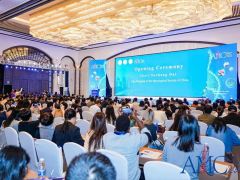
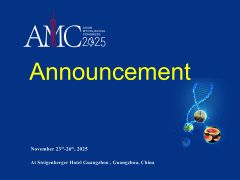
On November 26th, the 2025 Asian Mycological Congress, co-hosted by the Asian Mycological Congress (AMC), the Mycological Society of China (MSC), and Zhongkai University of Agriculture and Engineering, concluded successfully in Guangzhou.

The closing ceremony was presided over by Bai Fengyan, Vice President and Secretary-General of the Mycological Society of China, and Professor at the Institute of Microbiology, Chinese Academy of Sciences. Cai Lei, Vice President of the Asian Mycological Congress and Professor at the Institute of Microbiology, Chinese Academy of Sciences, and Cheng Ping, Member of the Standing Committee of the National Committee of the Chinese People's Political Consultative Conference (CPPCC), President of the Guangdong Provincial Committee of the Revolutionary Committee of the Chinese Kuomintang (RCCK), and Director of the Key Laboratory of Green Prevention and Control of Southern Horticultural Crops, Ministry of Agriculture and Rural Affairs, delivered speeches successively.
Cai Lei, Vice President of the Asian Mycological Congress (AMC) and Professor at the Institute of Microbiology, Chinese Academy of Sciences, pointed out that the successful holding of this congress in China—home to the world's richest fungal biodiversity and a profound mycology tradition—has demonstrated to the globe why Asia has emerged as a hotspot for mycology research and application.
He emphasized that the grand event brought together experts and scholars from over 30 countries, not only showcasing remarkable innovation capacity and in-depth scientific research that drive disciplinary development but also promoting ideological exchanges among researchers, educators, and industry experts, laying a solid foundation for future cooperation. He firmly believed that the insights gained at the congress would inspire future research, and the connections established would lead to significant new research progress in the years to come. He revealed that the new AMC Council would soon launch the call for the host venue of the next congress and looked forward to reuniting with colleagues in the academic community.

Cheng Ping, Member of the Standing Committee of the National Committee of the Chinese People's Political Consultative Conference (CPPCC) and Director of the Key Laboratory of Green Prevention and Control of Southern Horticultural Crops, Ministry of Agriculture and Rural Affairs, pointed out that as a top-tier academic event in the field of mycology, this congress, successfully held in Guangzhou for the first time, marks a milestone. She emphasized that the conference assembled more than 400 experts and scholars from 32 countries and regions worldwide.
Through 4 plenary lectures, 23 thematic symposia, 81 posters, and 170 oral presentations, it comprehensively showcased the latest research achievements in areas such as fungal biodiversity, systematics, edible fungi, and medicinal fungi, fully demonstrating the vigorous vitality and innovation capacity of Asian mycology research. The congress received a total of 350 submission abstracts, and the academic presentations selected through rigorous screening not only reflected high academic standards but also provided a valuable exchange platform for global mycologists. She expressed the hope that everyone would revisit Guangzhou, the "Flower City," and Zhongkai University of Agriculture and Engineering for guidance and exchanges, carrying the academic gains and wonderful memories from this congress. She believed that with the joint efforts of all parties, mycology research would embrace a more brilliant development prospect.

During the congress, the "Excellent Student Presentation Award" was established. Seven students from Zhongkai University of Agriculture and Engineering, Mae Fah Luang University (Thailand), Kunming Institute of Botany, Chinese Academy of Sciences, University of Santo Tomas (Philippines), National Autonomous University of Mexico, Thammasat University (Thailand), and Guizhou University were honored with this award. Guo Liangdong, President of the Mycological Society of China, presented the awards to the winners. The award aims to recognize outstanding young students for their academic research and presentation performance, highlighting the congress's emphasis on nurturing reserve talents in mycology.

In addition, the congress also set up the "Excellent Poster Award." After rigorous evaluation by the review committee based on three aspects—academic originality, research value, and poster presentation effect—10 winners were finally selected. Guo Liangdong presented the awards to the recipients.

The "Excellent Organizer Award" was also conferred at the congress. Xu Biao, Vice Dean and Professor of the College of Agriculture and Biology, Zhongkai University of Agriculture and Engineering, and Ishara S. Manawasinghe, Associate Professor at the Beijing Academy of Agriculture and Forestry Sciences, were honored with this award for their pivotal roles in the conference preparation. Nguyen Duc Hoang Pham, Secretary-General of the Asian Mycological Congress, presented the awards to the winners.

Upon the successful conclusion of the congress, special tribute was paid to the groups that made silent contributions behind the scenes. A volunteer recognition session was specially arranged, where Zhou Xinhua, Director of the Development Planning Department of Zhongkai University of Agriculture and Engineering, Yu Guohui, Dean of the College of Agriculture and Biology, Zhongkai University of Agriculture and Engineering, and Deng Wangqiu, Researcher at the Institute of Microbiology, Guangdong Academy of Sciences, jointly presented honorary certificates to volunteer representatives, expressing sincere gratitude to this dynamic and dedicated team.

The successful holding of this congress is not only a victory for academic exchange but also a result of the joint efforts of all parties. From the careful preparation by the hosts and organizers, to the active participation of experts and scholars, and the selfless dedication of volunteers, every link is closely connected and indispensable. It has not only promoted research and cooperation in the field of Asian mycology but also injected new vitality into the global development of mycology. In the future, it is believed that with the continuous efforts of all parties, mycology research will make constant new breakthroughs, contributing more to human health, agricultural development, and ecological environment protection.